I'd give the movie, overall impact, a 7. I think we were fairly successful in telling a grand story in a concise "slice of time" way. The story left me thinking of ways it could have been improved interns of pacing, dialogue, and filming but overall I think it was pretty true to my original intent.
The main idea stems from the real life story of how wall street employed, as a tool, derivative equations to fleece the unsuspecting public. Themes of income inequality and class have always captured my attention from A Christmas Carol to Citizen Kane to They Live so it was only natural that I should persue similar themes.
I think the story was pretty cler but there are certainly things I would do differently. All the scenes were pretty clear. I don't think I have any issue recalling any scenes.
The story feels complete to me. Scenes 1: 5 scene 2:7 scene 3:6
The settings were pretty weak and if I had it to do over I wouldn't be a slave to period. I originally planned for part of it to be a period piece set in the mid 80's and that caused me to make poor choices for setting. I realize now that unless I have the resources to do a period piece then I don't need to sacrifice the integrity of the set and scene.
Wednesday, April 11, 2012

Wednesday, April 4, 2012
Assignment writeup
I color corrected my footage, giving the first act a warmer temperature, the second act (the flashback) is in black and white, and the final act is a gloomy cool color. I added a musical track and attempted to make my edits more aggressive. I pared the film down to about 5 minutes and 30 seconds.
Final Project
Elevator Line: "A homeless schizophrenic wanders the streets, tormented by memories of a better time"
The theme of my final project is the loneliness, despair, and indignity of homelessness, particularly homeless individuals with mental health conditions.
My final project is about a homeless man named Alfred Flannigan. Most of the story is told in montage. We see Alfred panhandle, spend the money on liquor, rummage through the garbage for food. We see him sleep on benches, in ditches, and get viciously assaulted by psychotic young punks. We humanized Alfred by exploring his previous, normal, life via flashbacks. Alfred led a very normal life until the age of 32 when adult onset schizophrenia struck him. His congenitally rooted mental imbalance cost him everything, including his wife and daughter. Now Alfred wanders the street, begging for money to purchase alcohol. Alfred is tormented by his only fully lucid thoughts, memories of his wife and daughter. The film is set contemporarily in Memphis. The tone of the film is one of somber tragedy and quiet desperation. At the end Alfred begins a suicide attempt by climbing on the railing of an overpass but a locket containing a picture of his beloved daughter falls out and causes him to reconsider for the moment.
I want to humanize the homeless, embodied in the character of Alfred Flannigan, and to demonstrate they are real people. We pass the homeless and indigent everyday and rarely give thought that they are real people with pasts, loves, and (broken) dreams. This movie is about the subtle dehumanization of an underclass.
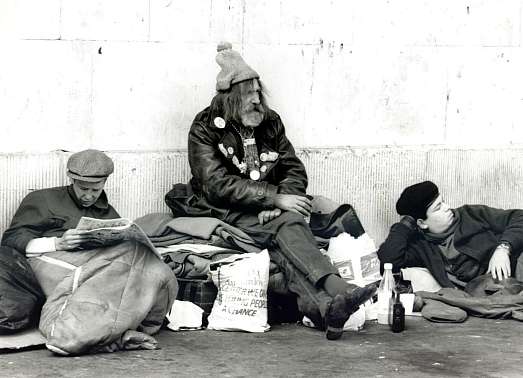
The theme of my final project is the loneliness, despair, and indignity of homelessness, particularly homeless individuals with mental health conditions.
My final project is about a homeless man named Alfred Flannigan. Most of the story is told in montage. We see Alfred panhandle, spend the money on liquor, rummage through the garbage for food. We see him sleep on benches, in ditches, and get viciously assaulted by psychotic young punks. We humanized Alfred by exploring his previous, normal, life via flashbacks. Alfred led a very normal life until the age of 32 when adult onset schizophrenia struck him. His congenitally rooted mental imbalance cost him everything, including his wife and daughter. Now Alfred wanders the street, begging for money to purchase alcohol. Alfred is tormented by his only fully lucid thoughts, memories of his wife and daughter. The film is set contemporarily in Memphis. The tone of the film is one of somber tragedy and quiet desperation. At the end Alfred begins a suicide attempt by climbing on the railing of an overpass but a locket containing a picture of his beloved daughter falls out and causes him to reconsider for the moment.
I want to humanize the homeless, embodied in the character of Alfred Flannigan, and to demonstrate they are real people. We pass the homeless and indigent everyday and rarely give thought that they are real people with pasts, loves, and (broken) dreams. This movie is about the subtle dehumanization of an underclass.
Wednesday, February 1, 2012
One movie that I have always found engaging was Savid Chronenberg's Viseodrome. I felt the movie was fairly sprophetic regarding the public's eventual obsession with violent media, interactive television (virtual reality), and corporate media's attempts ro game the political sphere (Fox News). The movie was heavily influenced by media philosopher Marshall McCluhan who was personified on screen in rhe character of Brian O'Blivion. Chronenberg's direction createa a surreal world where the audiencE, like the main character, ceases to be able to distinguish reality from hallucination.
Wednesday, January 25, 2012
The Maya Deren clip was really captivating and nightmarish. It was completely surreal and the framing of the scene created tension and made it phantasmagoric. I found Wong Kar Wai's first piece less interesting but the second was very well done and created a sense of claustrophobia. American Beauty is one of my favorite films and this scene was particularly good, opening with a frame of both of them seated at the dinner table. Mulholland Drive is another favorite with it's camera work and framing leading to a surreal, dreamlike feeling.
Subscribe to:
Comments (Atom)